
Single Enrollment System

for All Public Schools
Systems produce the outcomes for which they are designed.
The East Baton Rouge Parish public school enrollment structure has created a bifurcated system: one in which wealthier families get to choose among the best the system has to offer, and another in which lower-income families are assigned to struggling schools in their neighborhoods.
In Baton Rouge, the quality of a child’s schooling varies widely depending on which part of town they are from and the hoops the adults in their lives are able and willing to jump through. Data show that Baton Rouge’s top public schools serve middle- and upper-income families at significantly higher rates than they serve economically disadvantaged students, meaning poor students are much more likely to attend underperforming schools. The success of Baton Rouge’s charter school sector has offered some choice to lower-income families, but the overall scarcity of high-performing schools means some families will win and others will lose. In this system, the winners and losers can often be predicted based on family income.
All children in EBR—regardless of their zip code or household income—deserve access to a quality public education. Education is fundamental to breaking cycles of poverty, fostering personal development, and empowering individuals to reach their full potential. Every child should receive an education that not only prepares them for the life they desire but is also safe, led by dedicated and well-trained educators, utilizes a competitive curriculum relevant to students’ lives, and is accessible to all.
Unfortunately for the thousands of economically disadvantaged families residing in EBR —more than 1.5 times the national average—the public school system is not designed to serve them fairly. Our system offers many high-quality options to families, but the process for accessing them is often complicated, inconsistent, and burdensome. Families across the city struggle to navigate the system effectively, leading to missed opportunities and unequal access to quality education. In too many cases, this perpetuates the cycle of poverty.
Enrollment Complexity Varies by School Model
Baton Rouge’s public schools generally fall into three categories: traditional neighborhood
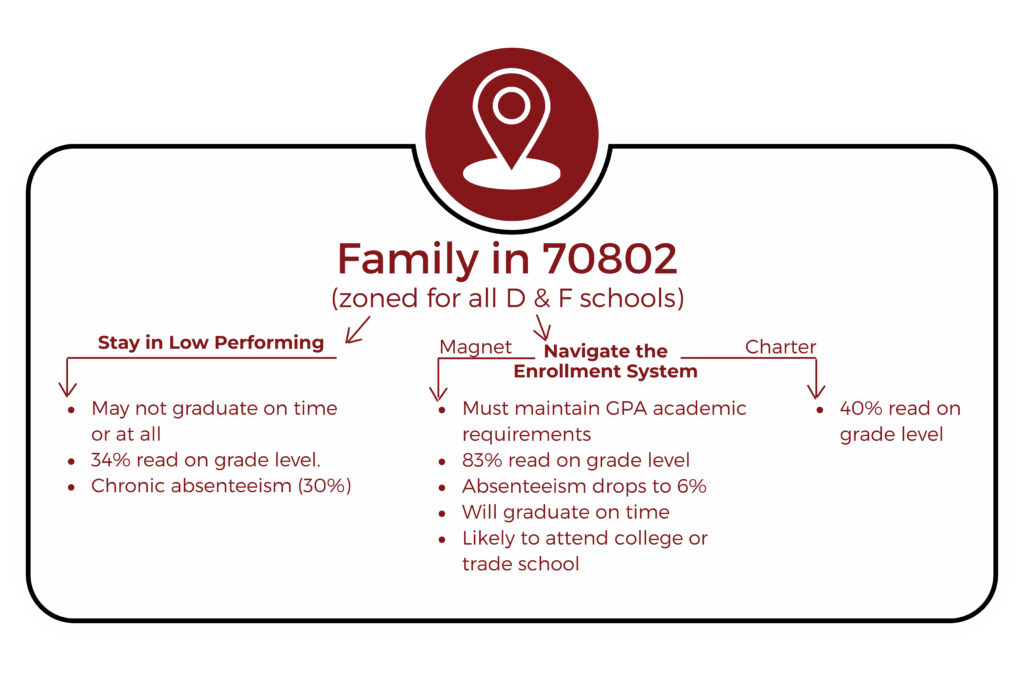
schools, magnet schools, and charter schools. Traditional neighborhood schools are where students are assigned based on their home addresses. These schools have the simplest, most straightforward enrollment process, but are the system’s lowest-performing as a whole. For example, the parent of a rising kindergartener living in the 70802 zip code can enroll their child in their neighborhood school—let’s say Capitol Elementary—by stopping by the front office or completing an online application before the first day of school. The process is straightforward.
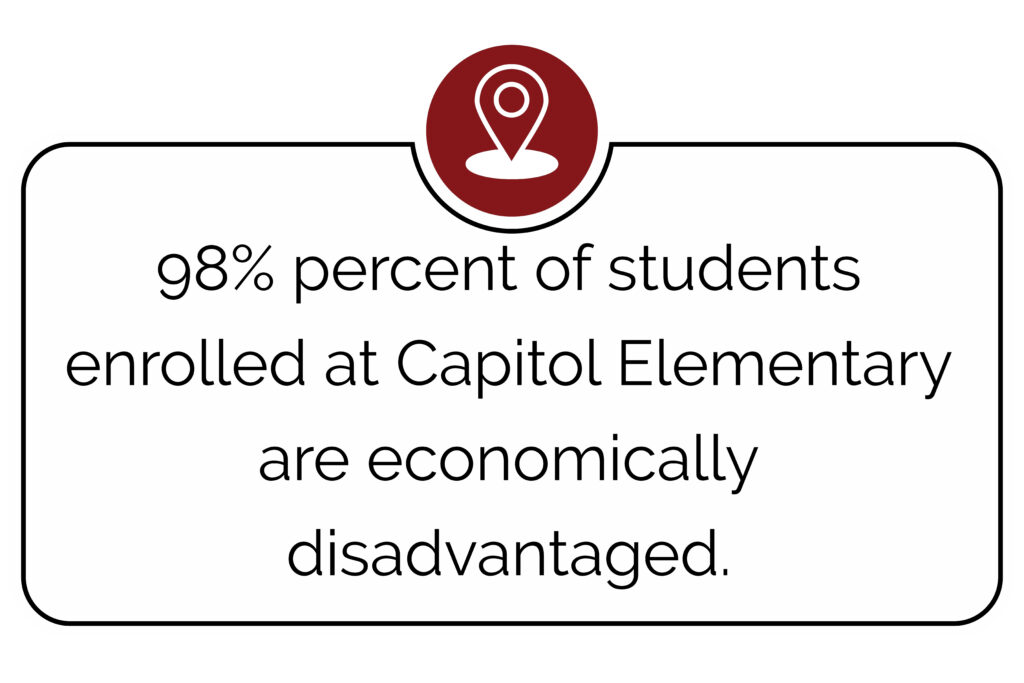
However, Capitol Elementary has a 2024 School Performance Score (SPS) of 56 out of 150, which is equivalent to a letter grade of D. The great majority of students there are not reading or doing math on grade level. Systems produce the outcomes for which they are designed.
Because many neighborhood schools in the city are rated D or F, a school choice policy is in place that allows families to seek alternative options for their children. Perhaps the parent in 70802 is looking for a better-performing school. To find a traditional option, they have to look outside their area. For some families, the prospect of a long daily bus ride in Baton Rouge traffic makes higher-performing schools in far-away neighborhoods impractical.
The Highest-Performing Schools Are Hardest to Access
A magnet school may be a better option. They are the district’s top-performing type of school, with an average 2024 SPS of 101 (A), and are clustered in the middle of the city. The admissions criteria are competitive, and the process is rigorous. Students entering Kindergarten must pass a screening test to compete for a magnet spot. Once all admissions requirements are met, the
seats are assigned via a lottery-based system.
A child who is zoned for Capitol Elementary can apply for a spot in a magnet program—for example, the Baton Rouge Center for Visual and Performing Arts (BRCVPA), an A-rated school in a recently rebuilt facility.
-
The initial process for applying to a spot in a magnet school includes:
-
Schedule and take a screening test (Kindergarten only);
-
Complete an online magnet application through the EBR Magnet Programs Portal, submitting it within 3 days of starting;
-
Upload proof of residency and signature page within four days; and,
-
Upload previous academic records and test scores.
From there, the next steps vary by school, with some requiring the same documents to be hand-delivered. Completing the process will require internet access, a printer, transportation, and time off during business hours, all of which give higher-income families a leg up. Another major consideration is timing. The magnet priority application period opens up in October, just a few short weeks after school starts for the year. Applications submitted between October and December are placed in the priority pool and are more likely to be accepted than those submitted later in the school year.
Unfortunately, this process must be repeated for entrance into both middle and high school. For our example, the student from 70802 will matriculate to Mayfair Laboratory School, one of the top-performing schools in the state, located in the 70808 zip code. At Mayfair, just 25% of students are economically disadvantaged, compared to 89% in neighborhood schools. The application period is open from October 6 through December 5. At the end of this period, the first lottery draft is done, and seats begin to fill up. Magnet school applications are accepted year-round; however, those submitted during the Fall priority pool have the best chance of being accepted.
Charter Schools Offer Options Through Another Enrollment System
If the student is not accepted into their first-choice middle school, parents must reconsider their options. In 70802, approximately half of the open-enrollment public schools offering a 6th-grade education are D or F-rated. This is one of the reasons why charter schools play such an important role in our public school system: they offer options to families, often in terms of performance but just as often in terms of program, model, or other factors.
While 79% of charter schools in EBR are rated A, B, or C, this is true of only 50% of comparable district-run, traditional neighborhood schools. On average, EBR charter schools are growing students’ academic achievement faster than neighborhood schools. Additionally, charter schools are scattered across the city, making them more accessible to a broader number of families; however, not all charter schools offer transportation.
Application deadlines and requirements for charters in Baton Rouge differ from those for magnet schools. Applying to most charter schools in EBR can be done via the EnrollBR website, where a parent must create a family profile, submit an application, and make their school selection. If accepted by the chosen school, then the parent must log back in to accept the offer.
The EBR School Board and system leadership have the power to address these disparities, and they possess the authority to demand and design a system that works clearly, fairly, and efficiently—for every family.
The complexity of the current system helps higher-income families take advantage of the highest-quality options at a greater rate than economically disadvantaged students, who are concentrated in the district’s worst-performing schools. Parents with more resources, education, and power move swiftly through the line for EBR’s top-performing schools, while low-income students remain in the worst-performing schools. Our city’s most at-risk children are the most at risk for being underserved.
Some argue that lower school performance scores among schools with higher populations of economically disadvantaged students are simply a reflection of the children’s household income. At the Alliance, we argue that they are a reflection of the schools’ success at meeting the needs of the students they serve.
What would it look like if Baton Rouge had one easy-to-navigate system?
A common enrollment system is an opportunity for the school board to design a student and family-centered pathway to accessing our city’s schools. It need not be limited to creating a streamlined, single access point. It can also include commonsense adjustments, like a single timeline that starts later in the school year (Spring instead of Fall), giving parents time to evaluate their current school and consider their options.
When the common enrollment window opens, the parent of a kindergartener living in 70802 could walk or bike to the local library, visit one website, enter their student’s information, strengths, and educational interests, learn about all of their educational options, and quickly enroll their student in the public school that best fits their needs. Applying to public schools in EBR would be a one-step, online process, created and overseen by the school board.
Every public school family in the parish would have the same application process and experience, and the online system would provide every public option available. Maybe the best school for their student is across town, or maybe it’s just up the street. The point is that families, regardless of their economic situation, would not have to worry about a lack of resources or information standing in the way of accessing the best option available for their student.
The job of the school board is to ensure that every family can access a quality
education, and that work starts before children ever set foot in school.
The days of complicated application processes, multiple enrollment periods, and differing deadlines should end, streamlining enrollment across all public schools and prioritizing the expansion of access to the growing number of high-quality school options to better serve families.
Common Enrollment Gives Educational Leaders Critical Insights
Streamlining enrollment is not only a technical fix and a moral imperative. It’s also operationally strategic and smart. Today, the EBR School Board, like others across the country, is managing declining enrollment and a rapidly changing education landscape. They’re also anticipating inevitable changes should voters support a new district in St. George, in addition to facing a facilities tax renewal just on the horizon. To have a system of schools that works for all families, education leaders must know what families want and develop a system to deliver it.
A common enrollment system will not only increase access and choice while cutting red tape, but also provide the district with knowledge about what families want from schools.
When parents have the opportunity to make choices about the schools their children attend, the district not only ends up with more satisfied families, it also gets a deep understanding of what families need and want. For instance, more parents choosing schools with a vigorous orchestra program tells the Board to increase music funding. Similarly, parents choosing schools with before- and aftercare gives the Board actionable information about critical programs to help families thrive. Responding to that knowledge through informed budgetmaking and future facilities realignment can create a stronger, smarter, more resilient school system.
Access to quality information is a game-changer for policymakers. With common enrollment, education leaders gain visibility into family desire and school needs. Knowledge provided by a common enrollment system can provide a strong foundation for the changes brought on by declining enrollment, a potential St. George district, and the upcoming May 2028 facilities tax renewal. The 10-year sales tax generates nearly half a billion dollars for capital expenditures on facilities and requires an intensive planning process rooted in community needs.